March Madness.
The time of year when we collectively thumb through FG percentages and rebound statistics of 18 to 22 year-olds from schools we have never heard of. We join pools, compare predictions and talk trash (“not many people know about that kid from St. Whatcha-call-it”). For some of us, it is the only time of year when we participate in any company sponsored event.
And it all leads up to the greatest three weeks in sports: The NCAA Tournament.
David slays Goliath and the buzzer gets beaten. Cinderella runs wild and there are ill-advised time-outs. Legends are born and goats go down in infamy. It’s just … awesome.
At the same time, we are inundated with other, non-basketball related “brackets” in March. Rock bands, movies, TV shows, and anything else you can think of have all been placed in a field of 64, and played out based on the publication’s opinion.
Well, that sounds fun.
Let’s do this Monty Carlos style, though.
This is our bracket and breakdown of the most important Americans ever.
First let’s clarify what we mean by “important”.
Lots of people have been important in both good and bad ways. Take Al Capone, for example, he is a very influential figure in American history. He shaped what organized crime looks like in this country and was a major influence in the formation of the FBI.
At the same time, he was also just one of many byproducts of the prohibition era — which was a step taken by someone else that was more influential.
That is the level we are going for — people that create “eras”. Americans that have created movements, innovations or ideas. The people that have shaped our values.
The real movers and shakers.
The goal was to mirror the actual NCAA Tournament selection process as closely as possible when selecting and seeding the field. To avoid any biases, several previous rankings of Americans based on “importance”, “influence”, “greatness”, etc were looked through to find three reference lists. We wanted a list that had a conservative bias, another with a seemingly neutral one and finally, a liberal leaning ranking.
Our barometer was Ronald Reagan.
We figured that where he landed was a pretty good indication of what the publication thought about politics. Funny thing is, this worked very well…
On the Discovery Channel’s list (which is an extremely conservative network), Reagan was number one.
In one of the few publications that takes pride in having no agenda and has been extremely moderate for over 150 years, The Atlantic, Reagan was 17.
And finally, we found our strong liberal bias on ranker.com. They did not have Reagan in their top 50.
Another good check on all of these was JFK. Where he sat gave us a pretty good indication of the publication’s political views and what they deem as “important”.
After ranking them, each was then seeded appropriately. Numbers one through four were 1-seeds, five through eight 2-seeds, etc. We also put in play-in parameters. Five people were seeded as 11- and 13-seeds with the last two playing each other in a play-in game accordingly. We did the same with 16-seeds; six individuals earned that seed with four of those squaring off in two play-in games.
The winner of each game is determined based on the importance of the mark these people left on society. How their accomplishments, influence or discoveries have made America what it is today; for better or for worse.
So, with that … Here is the bracket (we went ahead filled out the play-in games).  Exciting isn’t it? Bracket nerds like us are probably looking for upset picks and potential later round match-ups already.
Right away, in the Gettysburg Region, there is an intriguing 5-12 game between W.E.B. Dubois and Henry Ford. On one side, a self-admitted racist in Ford. While on the other, one of the fathers of our civil rights movement.
Moving down to Selma, Neil Armstrong is a trendy upset pick over John Adams. Everybody is salivating at the potential Sweet 16 match up of MLK and Reagan, though.
Could the woman who made the position of First Lady what it is today (Eleanor Roosevelt) take down the only President to be caught cheating on one?
Mark Twain got a terrible draw with the tricky Samuel Morse and his codes…
It’s madness I tell ya.
Before we move on to the first and second round winners, let’s first mention those that barely missed the field and recap the play-in games.
The first four out (in no order) were Sam Walton, George W. Bush, Louis Armstrong and Babe Ruth. The next four: Oprah, Steve Jobs, Alan Greenspan and Billy Graham.
Play-in game number one featured a match-up of duos. The inventors of airplane flight overtaking the pair that explored the West (we would have gone there anyways, Lewis and Clarke).
The two titans in architecture played a nail biter, with Frank Lloyd Wright winning. Unfortunately, he now has the luxury of playing Thomas Jefferson in Independence Hall.
Like it was originally intended, JFK bested LBJ and Hearst took the battle of journalism (which was played at Syracuse University).
Here is how the first couple of rounds played out: 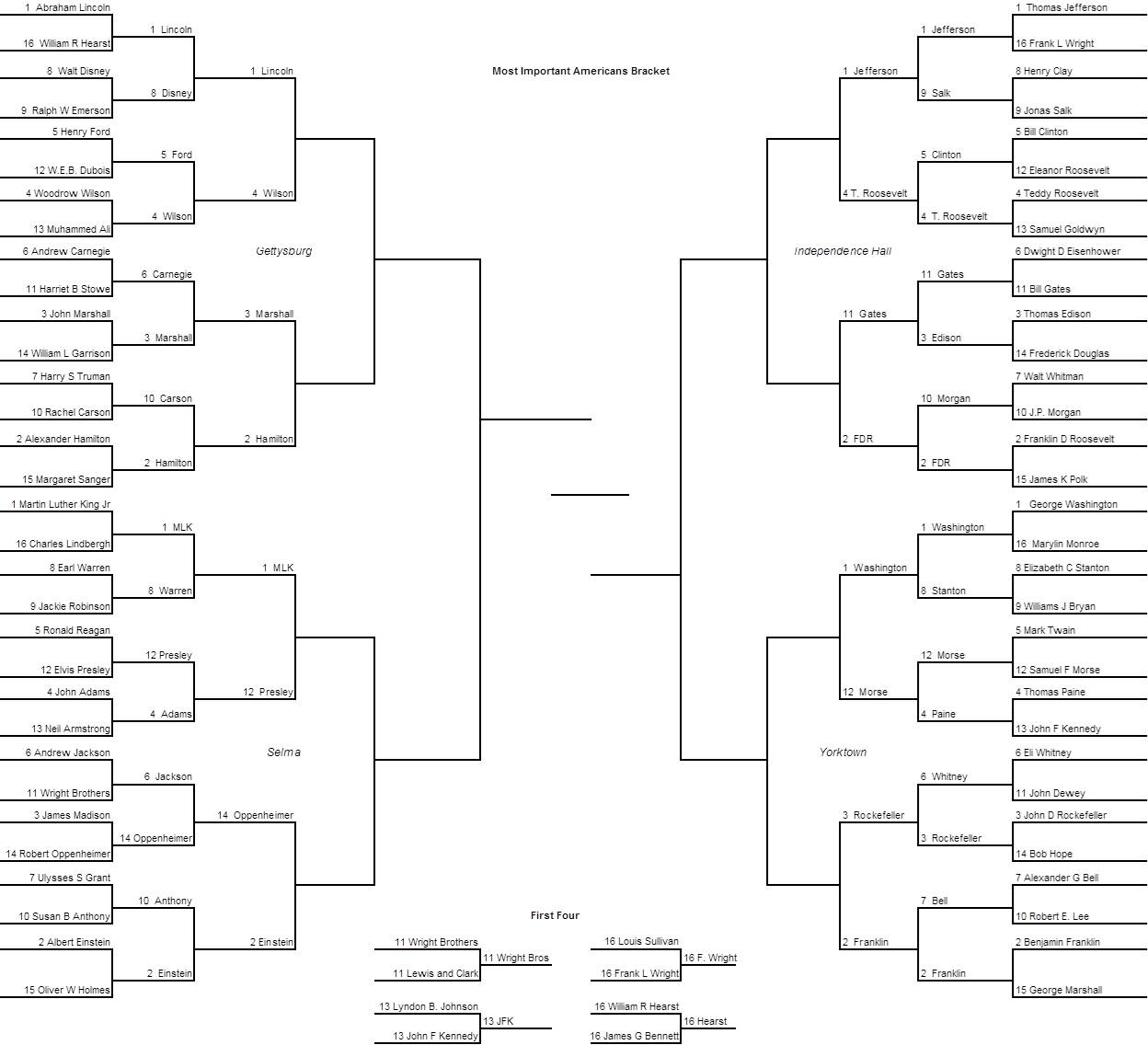 As expected most of our higher seeds advanced, but there were still some major upsets.
They say that in every NCAA Tournament there is at least one 5-12 upset, most of the time there are two or three. In recent years, 4-13, 3-14 or even 2-15 upsets are seemingly guaranteed.
March Madness America appears to be following form.
Gettysburg
Round of 64
In the round of 64, this region followed chalk for the most part.
The only first round upset was Rachel Carson over Truman. The pioneer of earth’s conservation movement easily took care of the guy who destroyed a lot of it.
Muhammed Ali got a technical foul for trash talking before tip-off. Woodrow Wilson started the game with free throws and the ball. He never really looked back after that.
It took a buzzer beater for Andrew Carnegie to get past Harriet Beecher Stowe in probably the most exciting first round game of the Gettysburg region.
Hamilton rolled; putting up a 30 spot on Margaret Sanger. She was just happy to finally be dancing, though.
Round of 32
Lincoln continued to look like the team of destiny in the second round by dismantling a normally tricky Walt Disney. The former juggernaut, Disney, has lost a step or two. He still sell a lot of jerseys though (too bad Mickey and Minnie never see a dime of it).
A pair of low scoring, grind it out match-ups saw Woodrow Wilson and John Marshall move to the sweet 16. Both of them proved that creating legislation is much more influential than what you do with it, beating Ford and Carnegie.
Looking Ahead
Wilson gets the Lincoln machine in the Sweet 16. Chief Justice John Marshall, the father of constitutional law and the supreme court as we know it, squares up with the high-flying Alexander Hamilton; the original “Philadelphia Lawyer”.
Selma
Round of 64
Coming into the tournament, Selma was easily the most intriguing region.It seemed to be top heavy with any of the first 5 seeds looking like they could go deep in the tournament. What we found instead: Upset central.
MLK looked vulnerable against a very under-seeded Charles Lindbergh, only winning by 9.
Chief Justice Earl Warren did not like his first round draw of Jackie Robinson, in a very interesting 8-9 match-up. Both influenced racial equality, but in the end education is much more important than sports and Warren was able to stave off the upstart Robinson.
John Adams, Andrew Jackson and Albert Einstein all took care of business against Neil Armstrong, the Wright Brothers and Oliver Wendell Holmes respectively (We hated seeing Holmes go as he is one of Monty Carlos’ biggest influences).
Perhaps he was caught looking ahead. Maybe we’ve given him too much credit for things that were not his doing (Nancy’s puppet). Whatever the reason, Reagan was bested by Elvis. The trendy Final Four hopeful is going home after just one game. Elvis had too much staying power and influence. Reagan got into foul trouble after threatening a fantastical and ridiculous space attack on the Russians … The tournament can be cruel.
The game of the tournament thus far, though, was the double over-time thriller between James Madison and Robert Oppenheimer. Madison, America’s book worm, the “Father of the Constitution”, a president, and the Secretary of State when Jefferson made the Louisiana Purchase, seemed like perhaps the strongest 3-seed in the field. But what a terrible draw … Oppenheimer is built to beat someone like Madison. The inventor of the atomic bomb is the only one in the field (besides maybe Einstein) that could out nerd Madison. He is also the only one who is more self-aggrandizing, “Now I am Death, the destroyer of Worlds.”
Finally, US Grant, the king of getting credit where it is not due, was upset by Susan B. Anthony. And it wasn’t even close. It is pretty clear that the North won because of technology, numbers and Lincoln, more so than Grant. His presidency showed that the Union victory may have really been in spite of Grant.
Round of 32
MLK and Einstein both looked to be in proper form disposing of Warren and Anthony easily.
The clock hasn’t struck midnight for Elvis and Oppenheimer just yet. They knock off two presidents and Sons of the Revolution in Adams and Jackson. Both couldn’t overcome their shaky reputations.
Looking Ahead
It’s not the match ups we were hoping for, but we have two battles of contemporaries in MLK/Elvis and Einstein/Oppenheimer.
Independence Hall
Round of 64
Although, not quite like Selma, the Independence Hall region also saw some notable upsets. At the same time, the highest seeds seemed to roll.
Jefferson took care of Wright without too much trouble. Edison handled Douglas. And, FDR looked scary good against James K Polk (despite Polk’s presidency of peace that many thought would give FDR a scare).
As for the other Roosevelt’s, Teddy looked good against the man behind Hollywood, Samuel Goldwyn. Eleanor did all she could for her husband’s New Deal, but missed some key free throws late and could never get over the Clinton “hump”.
Walt Whitman came limping into the tournament with most of his work antiquated in today’s society. He has the name recognition though, so the committee probably over seeded him a bit. And it showed. J.P. Morgan has come on strong as of late and has the talent to play with anyone. Morgan’s involvement in the creation of the Federal Reserve was just too influential when compared to Whitman’s legacy.
Much like his Presidential campaigns, Henry Clay just couldn’t get it done. He fell against the inventor of the Polio vaccine, Jonas Salk.
In the prime time game, we had our most surprising upset of the region thus far. Bill Gates defeats Dwight D. Eisenhower. His questionable presidency and perhaps a product of being in a good conference (with FDR, George Marshall, Patton and MacArthur) Eisenhower couldn’t live up to expectations and is packing up early.
Round of 32
Jefferson again looked strong against Clinton who kept it close for a while with his budget surplus. Despite both, deceiving the American public — one about freedom and the other about blow jobs — Dollar Bill just didn’t have enough firepower for someone on Mt Rushmore.
Both Roosevelt’s struggled and trailed late in the second half, but were able to avoid upsets in two exciting games.
The toast of the tourney seems to be Bill Gates. After taking out Eisenhower in the first round, Gates turned his cross hairs on one of our best minds in the field, Thomas Edison. It was Edison’s involvement with some shady figures that ended the inventor of light bulb’s tournament run. Instead of just creating a conglomerate and reaping the benefits, like Edison, Gates’ spirit of giving back has propelled him to the Sweet 16.
Looking Ahead
The possibility of an all Roosevelt regional final is out there.
Yorktown
Round of 64
Washington simply outclassed Marilyn Monroe. Monroe, who has the most undervalued intelligence in the field (with a higher IQ than Einstein), could have done so much for the world. Instead, she had an affair with a president and became addicted to barbiturates. No match for the man who kept our revolutionary army together at Valley Forge.
William Jennings Bryan lost another battle against enlightenment and logic. This time to Elizabeth Cady Stanton.
Samuel Morse brought the only first round upset in this region over Mark Twain. Proving that communication by many is much more potent than eloquent communication by one. Morse’s invention helped win the Civil War for the North and connected our country like never before (even more than the Mississippi River connected us).
The rest of this region was pretty much by the numbers. The only close game was a 2 point nail-biter between John Dewey and Eli Whitney. As many people as John Dewey’s work helped free, Whitney’s enslaved thousands more. That’s much more important in our history. Whitney also helped make the American South into the economic power that it was.
Round of 32
This region is still fairly uneventful with most of the higher seeds advancing.
Morse proved again the power of his telegraph, by taking out Common Sense author Thomas Paine.
Washington and Franklin both appeared to be in a different class than the rest in their wins.
Rockefeller struggled with Whitney, but oil is a much more important resource than cotton and has created just as many (albeit less flagrant) social issues. The battle of reluctant importance goes to Rockefeller.
Looking Ahead
Assuming that Washington and Franklin will take care of Morse and Rockefeller, everyone is looking forward to a potential clash of Revolutionary titans in the Elite 8 of this region.
The field of 16 remaining Americans is now set.
Let’s see how the rest of this thing plays out… 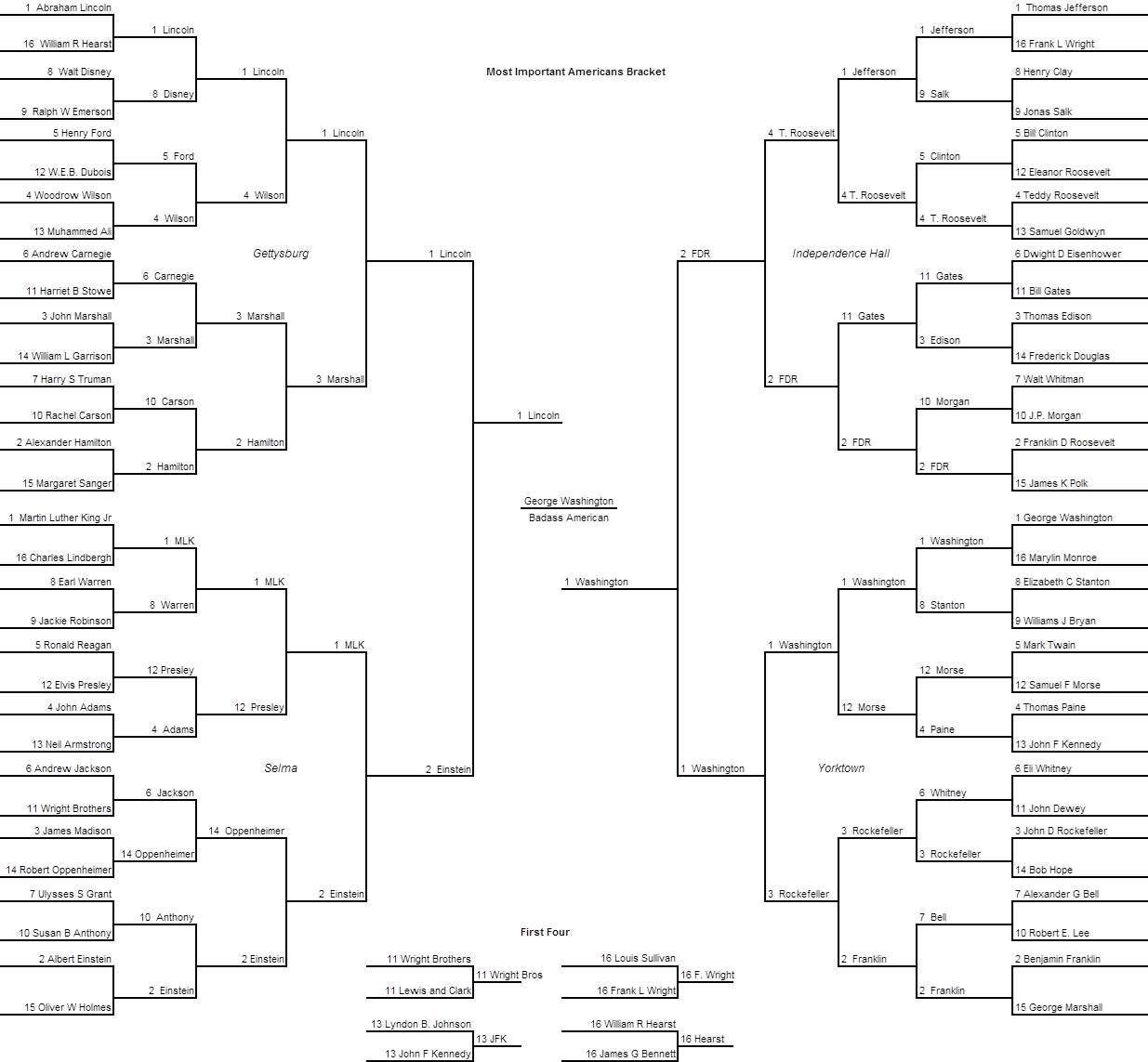 Gettysburg
After getting past Woodrow Wilson with few problems, Lincoln faced his toughest challenge of the Gettysburg region in the final against John Marshall.
Lincoln, a lawyer by trade, was able to anticipate every one of the Chief Justice’s moves and adjusted well; winning by seven and moving on to the Final Four.
Selma
After needing all 40 minutes and then some, MLK was able to squeak past Elvis — who played an outstanding tournament — in overtime.
In the other Sweet 16 match-up, our two strongest minds played a low scoring, extremely efficient game. Some called it ugly, others pragmatic. After getting by two politicians in the tournament already, it was science that actually bested Oppenheimer in an ironic result.
Perhaps suffering from a bit of a hangover, MLK could not figure out Einstein’s zone and the first number one seed fell (lol at saying MLK had a hangover).
Albert Einstein moves on to the Final Four where he’ll face Abraham Lincoln.
Independence Hall
The region of the Roosevelts proved to be just that.
In our first game, Teddy’s accomplishments, iconic personality and his gift to the world (the Panama Canal), over-powered the pencil pushing Jefferson. In this battle of two Mt Rushmore honorees, it was Teddy’s overall American-ness that gave him the edge over Jefferson’s quasi European-ness.
In the other regional semi, Roosevelt again prevailed as Gates’ scientific greatness fell short to the symbol of the greatest generation.
In the all Roosevelt regional final at Independence Hall, FDR jumped out to a quick lead. And although the game remained close (with Teddy even taking the lead a couple of times), it never felt like it was out of FDR’s hands. FDR moves on to the Final Four to await the winner of the Yorktown region.
After the game, in a classy gesture, Teddy said that he was now his cousin’s biggest fan.
Yorktown
We were lucky enough to get the regional final we were hoping for at Independence Hall, but not so in Yorktown.
After Washington was able to take care of business against an outmatched Samuel Morse, Franklin wasn’t able to hold his end of the bargain in one of the best Sweet 16 games of recent memory. Leading by 7 with just under two minutes to go, Franklin missed critical free throws that would have put Rockefeller away. Rockefeller hit some big threes and Franklin was a little too informal (as he was known to be) with the ball. The one who captured a little bit of energy couldn’t hold off the man who captured the world’s energy. Just like that Franklin was eliminated. No dream Washington/Franklin match up.
Rockefeller eventually ran out of gas, though and the good guys won. Washington, who led a revolution based on economic freedom for all, dominated the man who did everything he could to take the economy all for himself.
Final Four
Our first match-up features men who had minds that changed the world; Lincoln and Einstein.
For all that Einstein did, though, he did not save or preserve anything. He just advanced us. Lincoln, on-the-other-hand, advanced our thoughts and kept us together. He freed slaves and preserved our union. This was a tough, close game, but in the end Lincoln came out ahead.
The night cap features two war time presidents of very different eras.
They both faced economic hardships, they both faced seemingly unbeatable enemies, and both prevailed (although FDR died shortly before victory was officially declared). Although our land was threatened during WWII, Roosevelt did not have the wolves in our backyard like Washington. Roosevelt never had to keep morale up after evacuating cities like Philadelphia and New York; Washington did. Roosevelt had a slew of brilliant generals and the best industry in the world. Washington had ragtag militia men and slept in a tent at Valley Forge. He was just too tough for FDR.
The Final
It’s what we were all hoping for when this thing started, isn’t it? There were upstarts that made their runs and disappointing showings. All along, though, it just felt like Lincoln and Washington were head and shoulders above the rest of the field.
Two different men. Two iconic Americans. Two people that influenced the world for generations after they died and still do today.
In the end it is Washington, though.
In one of the best tournament finals we have seen, Washington upends the favored Lincoln in an overtime thriller. Lincoln hit a deep three with only a few seconds left in regulation. After Washington wasn’t able to get off a shot of his own before time expired, it looked like Lincoln had all the momentum. Just like the momentum the British though they had after the Battle of New York …
This is where Washington is at his best.
He went on an 8-0 run in overtime that sealed the deal and Washington cut the nets down.
Oddly enough, it was the contributions to medicine that actually gave Washington the edge (huh?). When a smallpox epidemic broke out in his camp, Washington rolled the dice with a controversial method of combating the disease by smearing some of the infection over open cuts of still healthy soldiers. This was one of the first forms of vaccination.
Additionally, Washington was one of the first gay rights activists (huh? again). By hiring the homosexual Baron Von Steuben, a Prussian military genius that had been exiled from the Prussian military, Washington proved that America is a place for all individuals. It was a shrewd move militarily as the Baron’s expertise vastly improved Washington’s army. At the same time, he laid the framework for our American attitude: that this is a land of opportunity, no matter who you are. No army would hire Von Steuben, but America did. Washington’s only ask was that he worked hard and did his part. The Baron did and we won the war.
Washington was all things America: proud, convicted, moral, and intelligent.
He fought for freedom against tyranny, a belief all Americans share. He fought the tyranny of taxation without representation, of controlled markets, of the British army, of disease and finally the tyranny of social inequality.
Although there are no pictures or videos of Washington, accounts describe him as an all-around man. He was big in size, tough in mind and had that little touch of Southern accent in his voice which made him very endearing.
He was our first cowboy.
George Washington is the winner of our March Madness tournament. He is the most important American.
 Monty Carlos