
0, 1, 1, 2, 3, 5, 8, 13, 21, 34, 55, 89, 144, 233…
Fibonacci’s Sequence: Starting with 0 and 1, new numbers are the sum of the two before it.
1.6180339… (continued infinitely) is the irrational number “phi”, or the golden number. Just as pi is a ratio associated with circles, phi is simply a ratio associated with line segments.
Divide a line so that the ratio of the length of the entire line (A) to the length of larger line segment (B) is the same as the ratio of the length of the larger line segment (B) to the length of the smaller line segment (C). Simply, think A is about 1.5 times B, and B is about 1.5 times C…
 To be exact though, this only happens at one point. And that is where A is 1.6180339… times B and B is 1.6180339… times C. It only happens at Phi. Alternatively, C is 0.6180339… of B and B is 0.6180339… of A. Going back to algebra, the relationships are then as follows: C=1P (phi), B=2P, A=3P. If you were to draw another line (D) that was 1.6180339… times A, then something curious happens, D=5P. Draw another and it equals 8P. And then 13P. Fibonacci’s Sequence; followed into infinity.
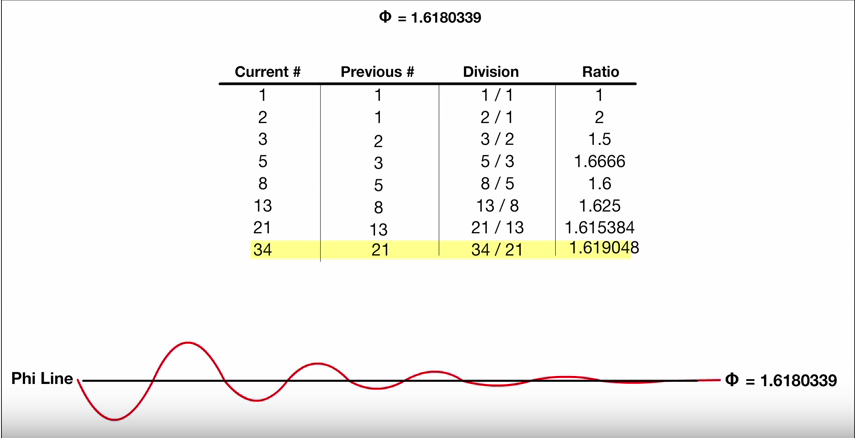 It gets even weirder… not only does the phi ratio follow Fibonacci into infinity, Fibonacci will actually continuously stride closer and closer to phi, but never quite land on 1.6180339…
For example, divide any number in the sequence by the number that precedes it: 1 divided by 1 is one; clearly under phi (1.6180339…). 2 over 1 is two, definitely above phi. 3/2 is 1.5 which is, again, under phi but a little closer. 5 divided by 3 is 1.666… and so on. It keeps going like this, oscillating above and below phi forever — but never quite making it.
It is also true that Fibonacci’s sequence is the mathematical root for all other equations. The reason for this is that Fibonacci only requires two numbers to perform (whereas every other sequence requires three).
The relationship between the two manifests itself in a spiral (below) which expresses phi and Fibonacci geometrically.
 It doesn’t stop there. The spiral — along with Fibonacci and phi — are found in all aspects of life everywhere. From various types of architecture and art to the physical makeup of living creatures and weather patterns, this geometry (most notably the spiral) is critical to the construction of our world.
Look at your hand. Each finger contains this ratio from phi to the next bone: from the tip of your finger to your first knuckle is 2P, from that knuckle to the next is 3P, then 5P to the last knuckle, 8p to your wrist, and so on all the way up your arm. At-the-same-time, phi oscillates from your tallest finger to your thumb.
The relationship is also true for the body as a whole — from your head to your fingertips is 0.6180339 of your height. Likewise, the height from the top of your head to your hairline is 1P, it is 2P from your hairline to your brow, 3P from brow to tip of nose, 5P from your nose to chin, 8P from your chin to middle of chest (even with heart), and it is 13P to your waste.
It’s not limited to humans either, phi and Fibonacci’s sequence are found in the makeup of insects, amphibians, reptiles, fish, birds, plants, and any of earth’s other lifeforms. They’re found in waves, hurricane storm cells and even the shape of our galaxy.
Understandably, us humans have always placed an importance on phi and Fibonacci’s sequence… They underlie our most sacred structures and art (even the Mona Lisa was painted based on them).
 Seeing the connections in life is just the tip of the iceberg with this stuff. It’s when you dive into the relationship between the two — and how they interrelate — that you can truly gain an understanding of how divine they really are.
As stated we can never quite reach phi through Fibonacci, but we can get close. We will continue to develop infinitely (unless we blow ourselves up) but never quite get there.
But what about the beginning? There had to be a jump from 0 to 1, right? Well, not exactly… There is no real beginning because the very act of going from 0 to 1 is just an attempt to replicate phi (which already existed).
Head spinning? It’s sort of like this … Phi tells life to replicate it and life says “I don’t know how to do that” — so, instead, life makes Fibonacci which can get pretty close but goes through steps along the way. It doesn’t just jump to Phi because it can’t. By starting with Fibonacci there is sort of a beginning … but we must remember that it’s all just a replication of something that already existed; the source (or phi).
The process also starts out crudely and not very close to Phi at all. Take, for example, the nautilus shell. At the center of a nautilus the spaces between each notch on the shell are not very close to phi. However, as it grows, the spaces inside the shell actually get closer and closer to the phi ratio at the same rate of oscillation that Fibonacci moves towards phi. Closer and closer to source, but never quite divine.
That’s just in one creature. When you expand this view to the evolution of an entire species it certainly helps explain a lot. Take man’s own evolution for example, we went from primitive ape-like beings to the advanced humans we are today. Do species make these steps in evolution at Fibonacci’s intervals? Perhaps. The possibilities are endless.
What is clear is this: Phi is just a number, but it is also source (or spirit or God or however you want to think of it); Fibonacci is just a sequence, but it is also life — created in source’s image and following intervals towards the divine. Thus, we could infer that the purpose of life is development itself; to strive closer and closer to source. We will never be able to get there. We will never be phi… but Fibonacci sure is fun.
 Monty Carlos