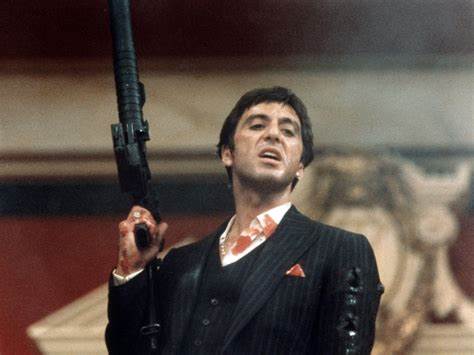
In the movie Scarface, Tony Montana kills 24 people by his own hand and is responsible for one more. He stabs some, executes a few and simply mows down others with a machine gun. Anyone that stands in his way of becoming a drug kingpin has a death wish.
In the Godfather trilogy, the epic story of mafia empire building in the 20th century, there are a total of 68 onscreen deaths. Some of these are due to illness but most of them are cold-blooded murder.
Casino has 25 killings. The Departed 21. And American Gangster checks in at 15. These are not just pistol shots to the head either… we’re talking sick and twisted murder, like burying someone alive.
As with Scarface, most of the onscreen death in The Godfather, American Gangster, etc. can be attributed to the protagonists… except these protagonists are far from “good guys.” They aren’t heroes who battle against the oppression of some evil doer. They don’t struggle for freedom or justice. There is no saving the day.
The main characters in these movies – whom we quote, emulate and perhaps even cherish – are, by most definitions, serial killers.
The difference is that Nicky Santoro and Frank Lucas do not kill for sexual urges, they do not slay dozens of people because of a chemical imbalance or repressed abuse as a child – they mostly just do it for money. Or maybe for power or vengeance, but it is almost always for a superficial end.
And for some reason we think that is okay. Or, at least okay enough to commission oil paintings of Tony Montana for our homes or wear a tee shirt with Michael Corleone’s face on it.
Curiously though, we don’t hang paintings of Ted Bundy or Jeffrey Dahmer in our homes… college bros don’t walk around with David Berkowitz tees on… killers that murdered fewer people (and often showed more mercy) than some of the movie characters whom we love so much.
Fictionalization is not the distinction here, either… The real life Al Capone, Frank Lucas, Whitey Bulger and countless others (whom these types of movies are based on) often do get the same hero treatment as their fictionalized characters. They are all thought of as, at worst, “gangsters”, and sometimes, “role models”.
But Capone, Lucas and Bulger are still serial killers. We just don’t put them in the “sick and demented” bucket like we do Bundy, Dahmer and Berkowitz.
Why is that?
Perhaps it is because of the only real difference between the two groups… motive. Gacy, Bundy and Dahmer kill for something like sex, while the gangsters kill for money.
For whatever reason, killing for money is much cooler than killing for sex.
The other difference is that even though both groups kill for power, there is this delineation of power. When asked, most of our traditional “serial killers” (not “gangsters”) will say they relish the feeling of power over their victims and this it is what keeps them coming back for more. This has been scientifically validated through observations of the brain, noting which parts stimulate when a serial killer describes a murder.
Gangsters kill for power too though, just a different kind… Whether it is power over another gang, their community, law enforcement, whatever, power is absolutely a motive for some killer gangsters.
The difference is that for the gangsters, it is power over many, as opposed to power over one individual with Dahmer or Bundy.
For whatever reason, killing for power over many is much cooler than killing for power over one.
Crazy, Not Insane
HBO recently released a totally engrossing documentary on serial killers called “Crazy, Not Insane”. In this film, the creators focus on a criminal psychologist who has worked with countless murderers over the years. The documentary shows how her work has been crucial to our collective understanding of a certain kind of serial killer – those that either pled “insanity” or probably should have.
The point of the film, though, and ultimately her work, is not to simply understand killers who have been deemed criminally insane, rather to study the similarities between those who have been ruled as “insane” and all serial killers. Further, it perpetuates the idea that the legal system’s definition of insanity is too tight and does not capture all forms of crazy.
The film posits that we punish criminals with very real mental illnesses the exact same way we would those without them, simply because the legal system isn’t aligned with modern psychology. The letter of the law defines “insanity” in a certain way but modern science and recent developments in mental health research have exposed this definition’s shortcomings. We now realize that it fails to capture certain types of mental incapacitation.
Simply put, the definition does not protect everyone who is crazy, just those who are “insane”.
So, what is the definition of criminal insanity? Generally speaking, it is understood as a mental defect or disease that makes it impossible for a defendant to understand their actions, or to understand that their actions are wrong. A defendant found to be criminally insane can assert an insanity defense for the crimes they committed and are protected from being subjected to standard punishment.
For some mental illnesses, like a personality disorder such as paranoid schizophrenia, this is a perfectly reasonable definition. People with disorders like this have extreme and inflexible personality traits that are distressing to the person and cause many social problems. In addition, the person’s patterns of thinking and behavior significantly differ from the expectations of society and are so rigid that they interfere with the person’s normal functioning. People with these kinds of mental illnesses do not understand how their actions impact others or society at-large and do not know when they do wrong. By all intents and purposes, if someone with a personality disorder commits a crime then they can and should be deemed criminally insane.
For other mental illnesses, though, like those that most people would absolutely say are a form of “crazy”, the definition would be better described as draconian than reasonable… For example, people with dissociative disorders (commonly, “multiple personality disorder”) do know how their actions are taken by the rest of society and when they commit crime, they are able to tell you in plain English that their actions were wrong. They just couldn’t control their dissociation at the time of the crime.
For the simple fact that they can recall the actions their alternate personality took and know that those actions were wrong, “multiples” will never be legally insane.
We just call them “crazy”.
Insane, Not Crazy
The United States has never fought a religious war. Congress has never declared war for nationalistic reasons. Civil war battles aside, the US has not had to fend off invasion by a foreign ground force since 1812.
We fight wars for economic reasons. Or at least, ultimately go to war when that domino falls.
Our country was formed on the idea of economic freedom in the Revolutionary War, where our first act as a nation was literally an economic protest in the Boston harbor. We fought several wars in the 19th century that expanded our economic control, whether with England/Canada, Mexico, Spain or ourselves. And we have been defending our right to buy and sell ever since; first in Europe, then in Asia, South America, and the Middle East.
It is pretty much the only reason why we engage in any conflict, whether tactical or declared war. Even those with many factors, like WWII, have economic implications (often underlying the seemingly non-economic reasons) that help drive our decision to go to battle.
And we are perfectly fine with this. If anything, today, we would collectively reject religious or nationalistic reasons for going to war (or really any reason besides economic advantage). Sure, we might mask our rationale as “protecting our way of life” but we all know this just means protecting dollars.
If our entire history is marked by bloodshed in the name of the almighty dollar, then we should remember that Al Capone’s and Frank Lucas’ popularity is not a recent phenomenon or a contemporary result of so much fictionalization over the years. They were just as popular and revered during their reigns as they are today.
This is because when they were in power, they gave everyday people what they wanted – booze, drugs, sex, and gambling. They let them share in the fruits that come with being a global economic power, things that the common citizen wouldn’t have access to on their own. Most Americans at the time would have even admitted that they viewed some of these serial killers (err – gangsters) as community heroes.
For their past contributions, present day Americans not only remember gangsters killing people for money but are still enchanted by them. Even in an era when we are constantly grappling with our past, the legacy of Capone, Lucas and Bulger has withstood the test of time. I guess murder victims can’t say #MeToo, though.
This makes one wonder if there is some sort of latent criminality deep in the sinews of America… if there is an understanding that killing a person is always an option if it involves a large sum of money.
We must then ask ourselves if it is Tony Montana mowing down 24 people for cocaine money or are we holding the machine gun?
Maybe we don’t know why we revere the gangsters who kill for money but draw a line when Bundy kills for sex… Perhaps we cannot explain why we differentiate between being generally powerful and asserting power over a specific individual.
Because we don’t even seem to understand that gangsters killing for money is wrong. In fact, we find it virtuous.
What kind of society finds virtue in that?
One that is insane, but not necessarily crazy.
 Monty Carlos