It was the left of times, it was the right of times…
Category Archive: Monty
With respect to Dave Chappelle… A Portrait of the Racist as Chris Rock.
Illuminati, Alien Barack Obama and Flat Earth… You’ll never believe who may be behind it all.
A review of psychology, religion and the significance of 9/12/2001.
We are proud to present our first Monty Movie! This self titled documentary short, “Monty Carlos” reviews contemporary America through a collection of news footage, film clips, and memes.
From George Washington’s wooden teeth to Maire Antoinette’s cake, history is always rewritten. What’s next?
If American States were Countries in Europe….
The United States of America will turn 239 years old in a month.
Ancient Greece, during the Hellenistic period, had an empire that was built on many of the same ideals as America’s. Their empire lasted around 225 years.
The Ottomans and British both dominated the world scene for about 250 years. The Russian Romanov Empire experienced 234 years of prosperity. Even the Roman Empire during its most dominant period, only lasted for roughly 207 years.
“Things go wrong so that you appreciate them when they’re right. You believe lies so you eventually learn to trust no one but yourself, and sometimes good things fall apart…” – Marilyn Monroe
The other day I was surfing Instagram and came across a short video that (at the time) had over 10,000 “likes” and close to 1,000 comments. Who knows how many it has now.
It was no mystery as to why it was so popular, though. Videos like this one always get lots of attention…
Pink is just red mixed with white.
In literature and art, colors are used to convey certain feelings believed to be universal. Everybody – no matter where they come from – is said to experience the same energies when consuming color in a given work or piece.
This phenomenon is called symbolism and the feelings or energies themselves are referred to as archetypes.
Some archetypes associated with red are violence, excitement and danger, while white is commonly used to convey purity, rebirth and wholeness.
Pink’s archetypes are a combination of the two … caring, tenderness and healing (particularly in times of grief or sadness). Pink conveys feelings of overcoming red to a state of white. Spring and rebirth are almost always connected to pink.
Red mixed with white.
“Uh, so let’s get going, there’s no other choice. God willing, we will prevail, in peace and freedom from fear, and in true health, through the purity and essence of our natural… fluids.”
My parents pointed out all these dead rabbits on the road when I was a kid. I didn’t know that much about the virus, or even how to spell it.
In 1944, Lt. Hiroo Onada, of the Japanese Imperial Army, was sent to the remote Philippine island of Lubang. His mission was to work with a small team of commando forces to destroy the main airfield and then initiate a series of guerrilla attacks on Allied forces holding the island.
Onada’s team was unsuccessful in destroying the main target and retreated inland. There, they regrouped and began to execute on the second part of their mission. They relentlessly attacked the Allies, but also lost men, supplies, and ground with each engagement. After several rounds, Onada and what was left of his group were forced to retreat deep into the uninhabited recesses of Lubang.
Eventually, the team of commandos lost everyone but the lieutenant. He was completely on his own.
March Madness.
The time of year when we collectively thumb through FG percentages and rebound statistics of 18 to 22 year-olds from schools we have never heard of. We join pools, compare predictions and talk trash (“not many people know about that kid from St. Whatcha-call-it”). For some of us, it is the only time of year when we participate in any company sponsored event.
And it all leads up to the greatest three weeks in sports: The NCAA Tournament.
David slays Goliath and the buzzer gets beaten. Cinderella runs wild and there are ill-advised time-outs. Legends are born and goats go down in infamy. It’s just … awesome.
At the same time, we are inundated with other, non-basketball related “brackets” in March. Rock bands, movies, TV shows, and anything else you can think of have all been placed in a field of 64, and played out based on the publication’s opinion.
Well, that sounds fun.
Let’s do this Monty Carlos style, though.
This is our bracket and breakdown of the most important Americans ever.
We love anticipation and revel in excitement. Time seems to pass more slowly when we are waiting for something.
Anticipation can build so much that, sometimes, reality itself is disappointing. It doesn’t live up to the expectations we set for it.
Whether you have counted down the days until a loved one returned, took candy from an Advent calendar or ever sat on pins and needles for something, you have anticipated.
It’s an aspect of thought that is dominated by us. Outside of Pavlov’s dogs, animals don’t really enjoy the sensation of waiting (and I’d argue that his experiment was hardly enjoyable for the test dogs). But, we do.
This is also why Return of the Jedi sucked.
Their names are in our history books: James, Dillinger, Cassidy, Bonnie, Clyde … The bank robbers of lore.
Their stories, triumphs and demises have been sewn into the fabric of our country and we have romanticized them in film and tv for decades. During their runs, most of us even rooted for them to get away. They were our Robin Hoods.
Their portrayal wasn’t always accurate, however.
Some of these celebrated criminals, like Bonnie and Clyde Barrow, were actually brutal and savage killers. Others, like John Dillinger and Butch Cassidy, rarely resorted to violence at all and really were the respected, noble men we believed them to be.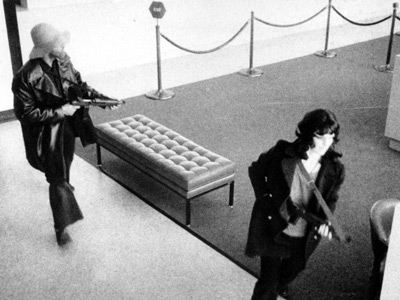
No matter their method or madness, these sack filling bandits baffled police chiefs, filled headlines, and were bigger-than-life celebrities of their time.
But, this phenomenon was short lived. In only a few decades, outlaws went from being household names to afterthoughts on back pages.
I remember it like it was yesterday … The moment I realized that I’ve had it wrong all along.
That sensation of stupidity overcame me; my face was hot with embarrassment.
Where I was. Who I was with. What was going through my mind. Everything about this moment can be recalled. Feeling completely helpless is still the most vivid memory.
It happened a few years ago during a discussion with friends. We were hanging out at my old house in the Upper Kirby area of Houston, TX, and were a few drinks deep. The alcohol started guiding the topics and we were soon talking about life’s bigger questions. One of those slightly-inebriated, deep conversations we have all had.
Somehow, money and banking came up, and my buddy’s quasi-hipster girlfriend (at the time) paused the conversation to ask a question. Little did I know that what she was about to inquire would cause my entire ethos to pivot — almost instantaneously:
“So … Where does money come from?”

It’s a simple question — with a simple answer. And no, not that type of deeper simplicity that is, in itself, complex. Just good old simple.
 Monty Carlos